

July 9, 2026 · 5 min read
The Weekly Demo: The Cheapest Insurance Against a Build That Drifts
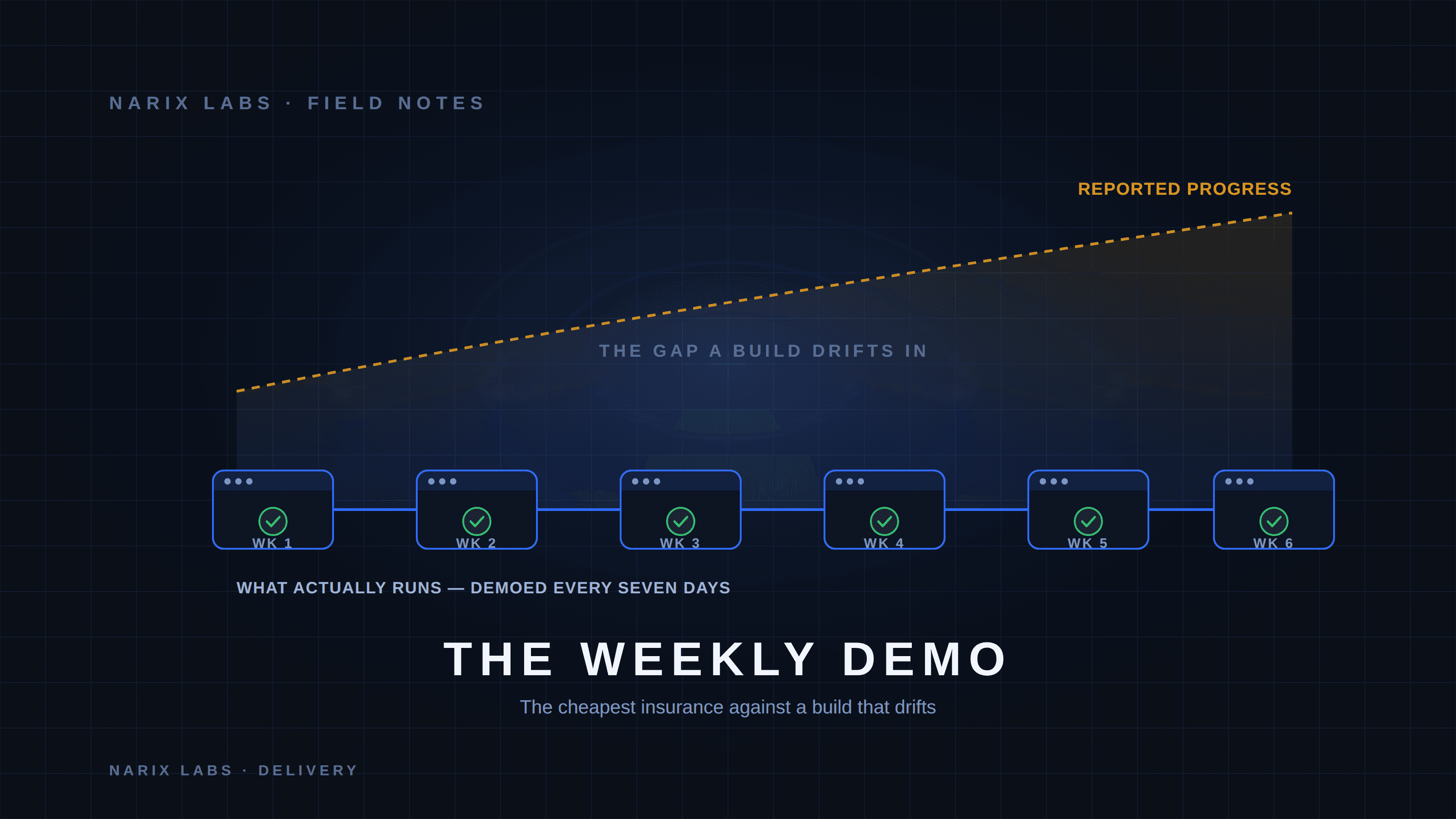
There's a version of a software build that goes wrong so slowly nobody can point to the day it happened. No missed deadline, no blowup, no bad news — just a demo that quietly becomes a status update, a status update that becomes a deck, and a deck that becomes a sentence: "good progress this sprint." By the time the drift is undeniable, it's months deep. This post is about the single cheapest habit that makes that impossible.
It's not a methodology. It's a working demo, every week, of software you can click.
What a demo is actually for
Ask most teams what a demo is for and you'll hear "to show progress." That's the sales answer. The real function of a weekly working demo is the opposite: it's the thing that makes lack of progress impossible to hide — from you, and from the team itself.
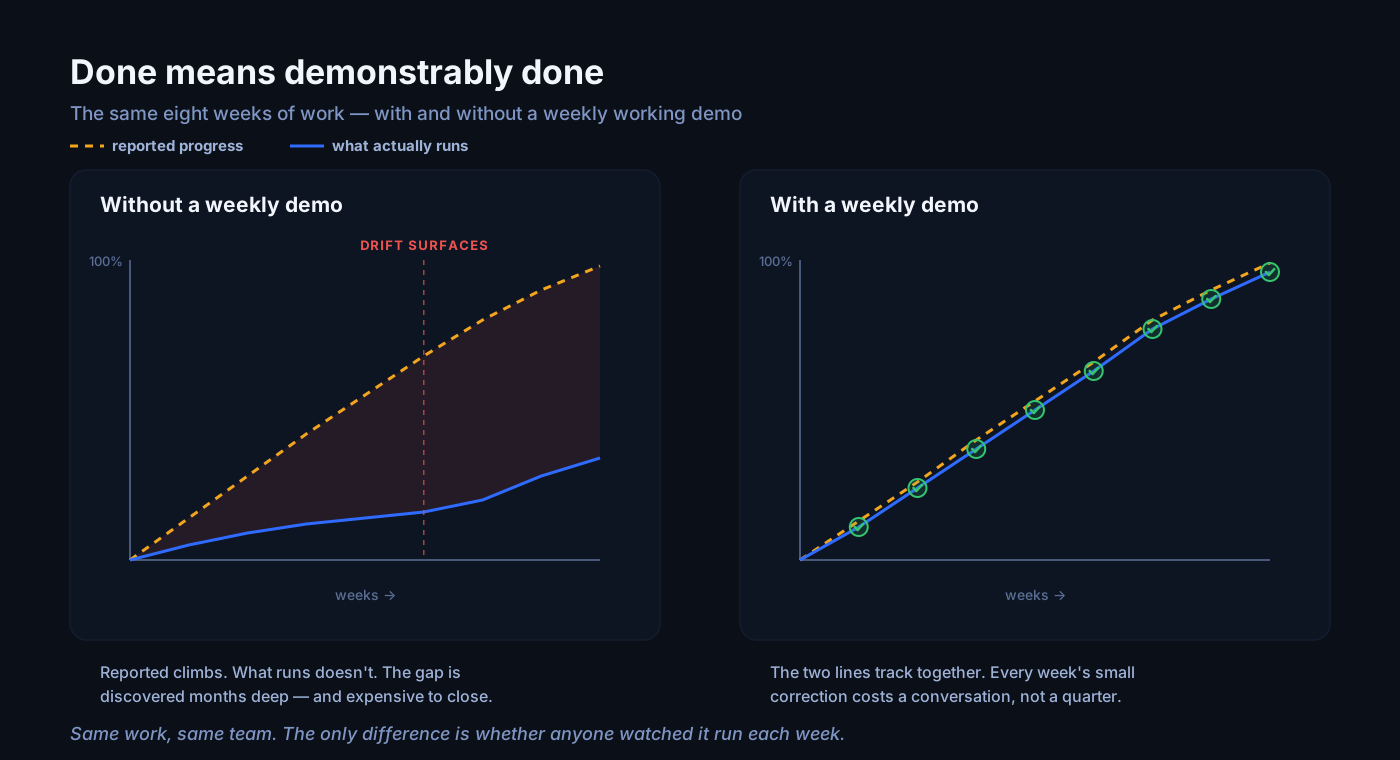
A build drifts in the gap between what's reported and what's real. Every layer of abstraction between you and the running software — a Jira board, a burndown chart, a slide that says "auth: 80%" — is a place that gap can live and grow. A demo collapses the gap to zero. Either the feature works when someone clicks it, in front of you, or it doesn't. There's no 80% of a login that works.
That's why the demo has to be working software, not a walkthrough of tickets. The moment "demo" means screenshots, a Figma, or a narrated tour of the backlog, you've rebuilt the exact gap the demo was supposed to close.
Why builds drift in the dark
The stalls we've written about before almost never announce themselves. They compound quietly, and they compound fastest when nobody's looking at running software:
- Small misinterpretations pull the build off-target. A feature gets built to the developer's reading of an ambiguous spec, not yours. Caught in a weekly demo, that's a five-minute correction. Caught in month five, it's a rebuild of everything stacked on top of it.
- "Almost done" accumulates. Work reported as nearly complete, sprint after sprint, is the most expensive lie in software — usually one the team believes. A demo forces "done" to mean demonstrably done.
- Integration debt hides. Pieces that each "work" in isolation but were never wired together look like progress on a board and reveal themselves as a wall the week someone finally connects them.
- The hard part gets deferred. The genuinely uncertain feature slides to "next sprint" while easier work makes the burndown look healthy. A demo asks, every week, to see the part you're most worried about.
None of these require anyone to be dishonest or incompetent. They're the default physics of a build nobody is watching run. The weekly demo is simply the cheapest instrument that keeps watching.
The founder's side of the deal
A demo cadence only works if it's genuinely two-way, and the founder's half is easy to skip. Showing up to watch isn't enough — the value is in what you do with what you see.
The discipline is small and specific: watch the actual software, not the narration around it. When a feature is demoed, ask to click it yourself, or ask for the one case you know is hard — the weird input, the returning user, the thing that broke last time. A demo you only nod along to is theater you've agreed to participate in. A demo you probe is a measurement.
And when something's off, the whole point is that it's cheap to say so now. The founder who holds corrections until they've piled into a formal review has thrown away the demo's entire advantage: that this week's misunderstanding costs a conversation, not a quarter.
Cadence is a skill, not a ceremony
Here's the part most teams underestimate: keeping a weekly working demo going is hard, and that difficulty is exactly what makes it informative.
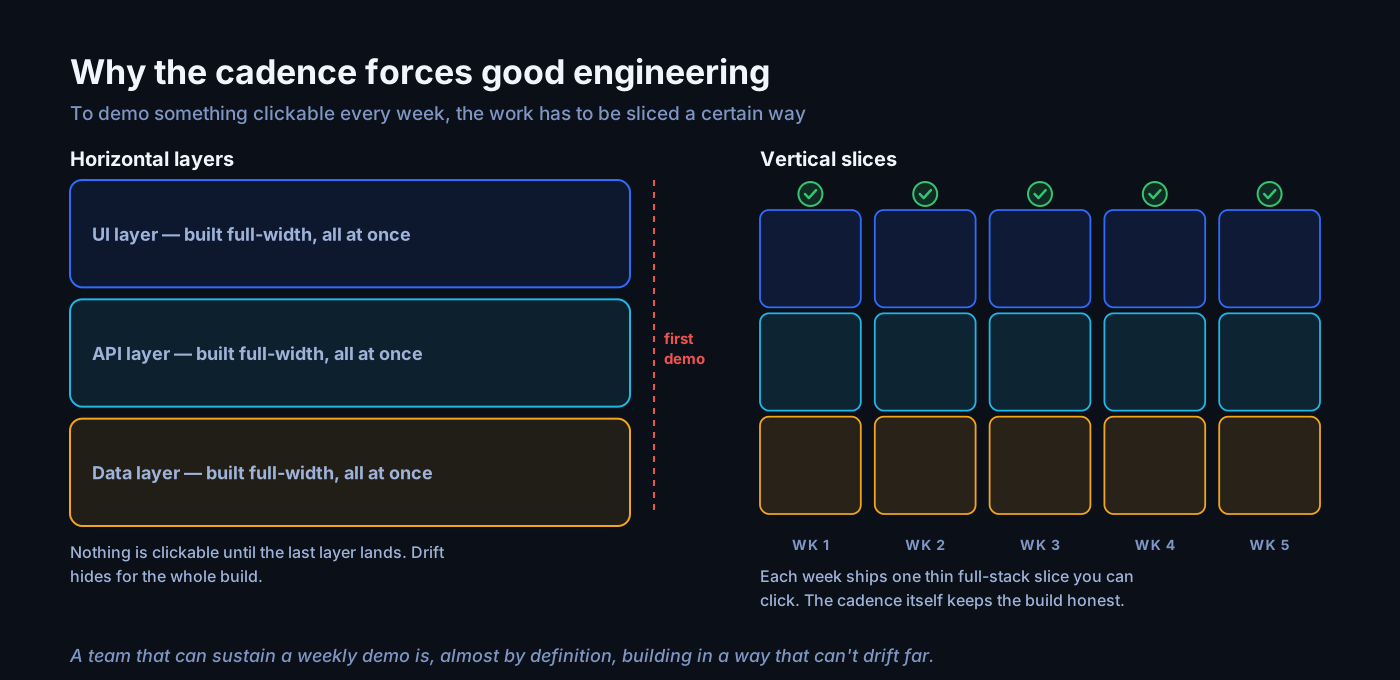
To demo something real every week, the work has to be sliced so that each week produces a clickable increment. That constraint quietly forces good engineering — vertical slices over half-built horizontal layers, integration continuously rather than at the end, the risky thing pulled forward instead of deferred. A team that can sustain a weekly demo is, almost by definition, a team building in a way that can't drift far. A team that can't keep the cadence is telling you something important about how the work is actually structured, long before a deadline would.
That's why "we'll demo at the end of the phase" should worry you. The end-of-phase demo is the one with nothing left to correct. The weekly one is the only kind that can still change the outcome.
Where this fits
Weekly demos aren't a standalone trick — they're the heartbeat of the Build phase, the same way a written definition is the output of discovery and a component-by-component verdict is the output of a Build Audit. Planning decides what to build and in what order; the Build delivers it in demoable slices; Care keeps it healthy once it's live. The demo is what keeps the middle honest.
It's also not abstract for us. Narix Labs' founding engagement is a takeover — inheriting a mid-build product from a previous agency and carrying it to completion while cutting the monthly run-rate by roughly 30%. The mechanism that makes a takeover keep its cadence instead of resetting to zero is exactly this: weekly working demos from the current state, so that "what's real" is re-established every seven days rather than assumed. Velocity per dollar improves because nothing is allowed to drift long enough to get expensive.
The short version
A build rarely fails on a single bad day. It drifts, in the space between what's reported and what actually runs — and the wider that space, the longer the drift hides. A weekly demo of clickable software collapses that space to nothing: done means demonstrably done, misunderstandings cost a conversation instead of a quarter, and a team's ability to sustain the cadence tells you how well the work is really structured.
If a build you're paying for hasn't shown you working software you could click in the last week, that's not a scheduling detail — it's the signal. Ask for the demo before you ask for anything else. And if you're not sure which front door you're standing in front of, the product readiness assessment takes a few minutes and points you at the right one.
Not sure where your product stands?
Take the free Product Readiness Assessment — ten minutes, and you'll know exactly what to fix first.