

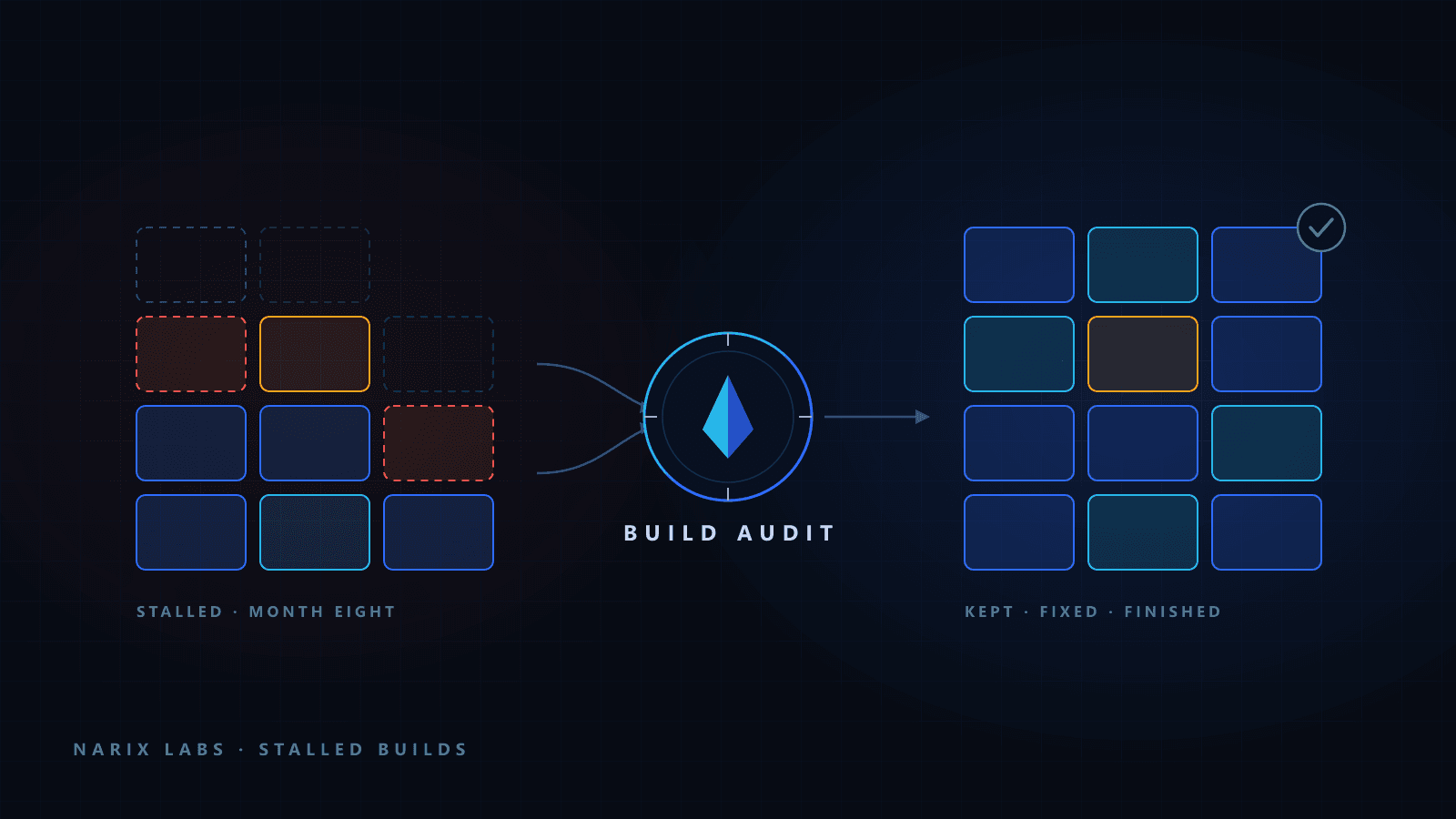
There's a particular silence founders learn to recognize. The weekly demos get shorter, then stop coming. Questions about the product start getting answered with process — "we're refactoring," "we're stabilizing," "next sprint." The invoices, meanwhile, stay perfectly punctual. Somewhere between month four and month eight, you finally say out loud what you've suspected for a while: the build has stalled.
What happens next usually gets decided in the worst possible conditions — under sunk-cost pressure, with no independent information, by the person with the least visibility into the code. This post is about deciding it differently.
The three doors
A founder holding a stalled build gets presented with three options, and every one of them arrives framed by someone with a stake in the answer:
- Keep paying. The current team's framing. "We're almost there" — the same almost there as three months ago, offered by the people whose revenue depends on you believing it.
- Start over. The next agency's framing. The old code is a mess, the architecture is wrong, the honest path is a clean slate — says the team quoting you the clean slate.
- Walk away. The advisor's framing, or the one you give yourself at 2 a.m. Cut your losses, write it off, keep the remaining budget.
Any of the three might be right. That's what makes the situation genuinely hard — the problem isn't the options, it's that you'd be choosing between them with no evidence. The state of your codebase is a fact. It's knowable. And right now, the only people in a position to tell you that fact are the people billing against it.
Why builds actually stall
Stalls are rarely dramatic. Nobody sabotages anything. The causes are boring and structural, and they compound quietly:
- The quote was a guess. A fixed number produced after two sales calls, attached to a product nobody wrote down — we've written about how that contract gets signed. When the guess runs out, velocity is the first thing quietly sacrificed to protect the margin.
- The product was never defined. Scope grew in every direction ambiguity allowed, and each unilateral interpretation pulled the build slightly off the founder's picture of it.
- Progress hid behind decks. No weekly working demo, just status theater — so by the time the symptoms surfaced, the drift was months deep.
- The one engineer who understood it left. And it turns out the architecture lived in their head, not in the repo.
- An early technical bet went sideways — a framework, an abstraction, a vendor — and got more expensive to unwind with every sprint built on top of it.
Notice what's not on that list: "the developers were bad." Plenty of stalled codebases contain good work by competent engineers operating under bad constraints. That's precisely why blanket verdicts on a codebase — it's all garbage, it just needs two more sprints — should make you suspicious. Real codebases are rarely uniform.
The rebuild reflex
Show a stalled codebase to a new agency and the verdict comes back "rebuild from scratch" suspiciously often. This isn't necessarily dishonesty. It's incentives.
Inherited code is work an agency can't confidently estimate and can't take full credit for. A greenfield rebuild is both. Condemning someone else's code is also the safe call — nobody gets blamed for recommending a clean slate, and every engineer who ever lived prefers writing code to reading it. So "rebuild" is what the reflex produces, before anyone has read a line.
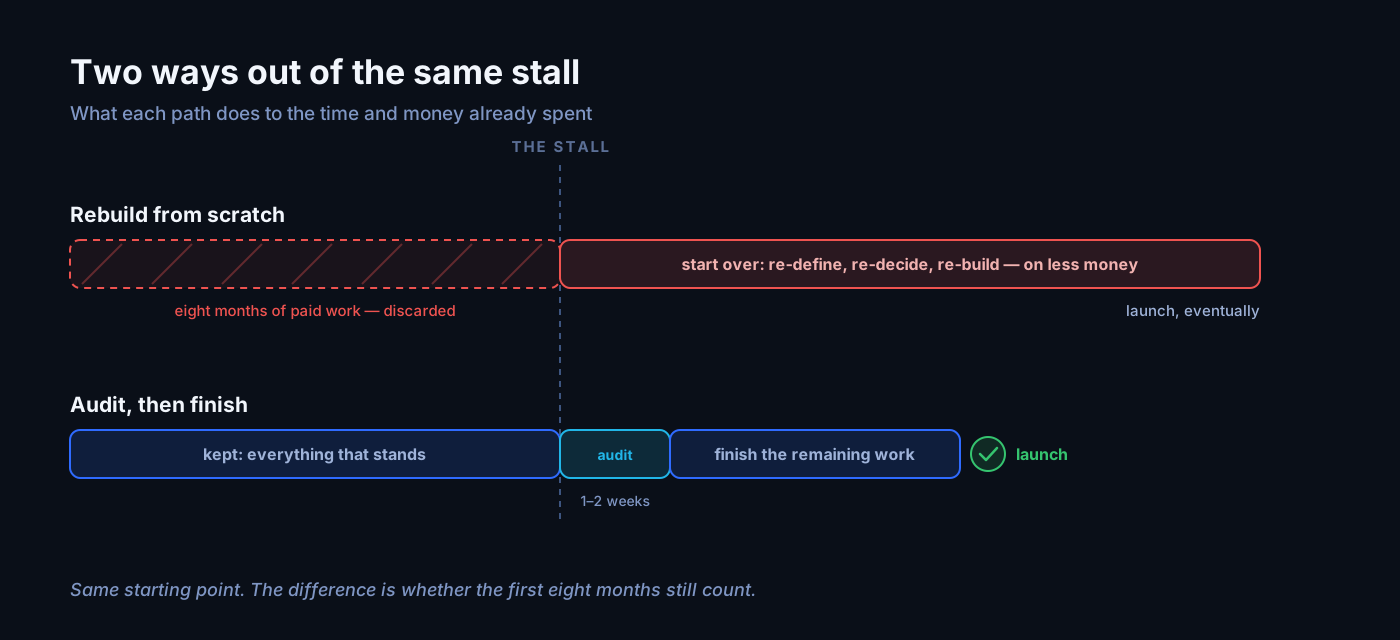
But look at what a rebuild actually buys you. It recreates the exact conditions that stalled the first build — a product still not written down, another optimistic quote, another team starting from zero — except now with less money and less patience. And it throws away the most expensive thing you own: the lessons the first build already paid for. The schema decisions that turned out to be right. The third-party integration that actually works. The edge cases discovered the hard way, handled, and now sitting in code someone wants to delete. You bought those lessons once. A rebuild bills you for them twice.
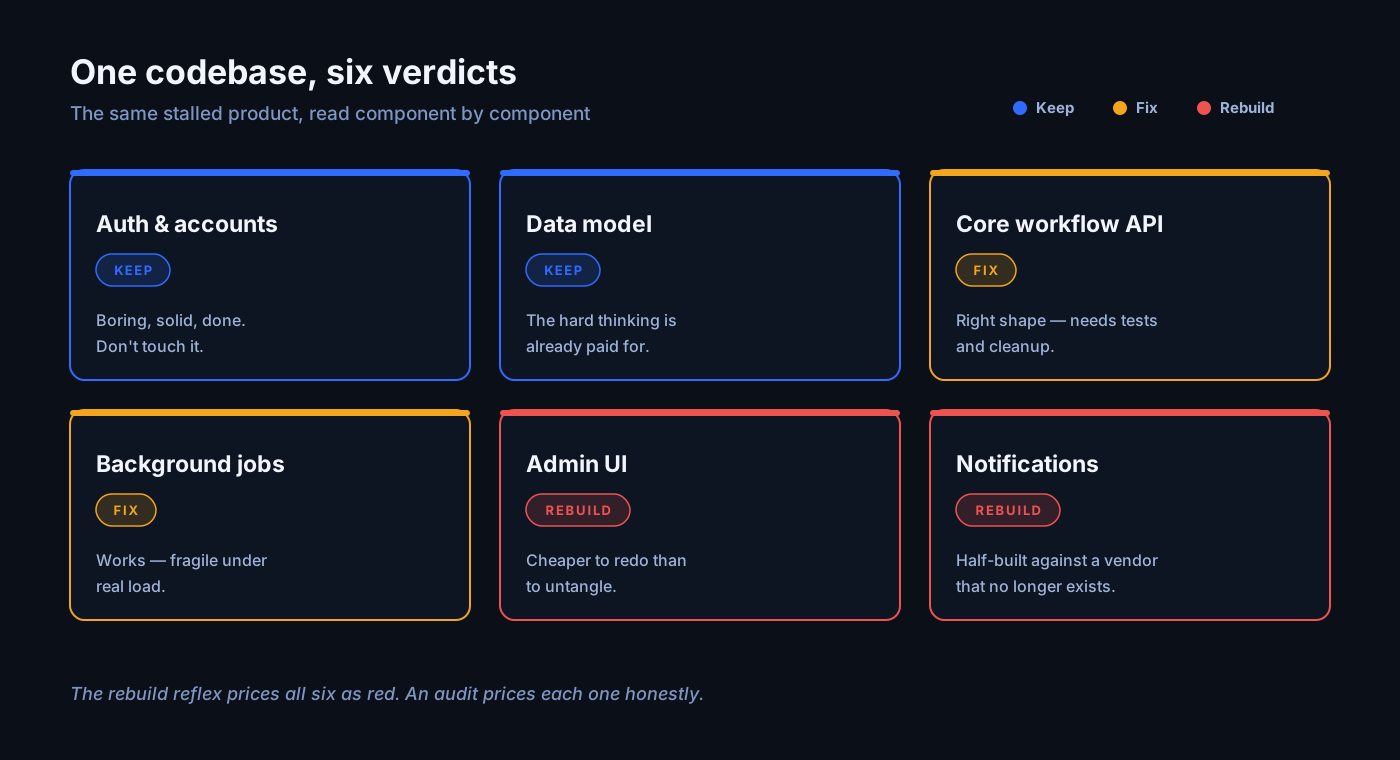
Here's the truth the reflex skips over: salvage-versus-rebuild is not a codebase-level question. It's a component-level question. A stalled product is almost never uniformly rotten — it's a mixed estate, and the honest verdict reads component by component.
What an honest audit produces
A Build Audit is the same move as product discovery, through a different front door: one to two weeks of reading, running, and testing what exists, ending in a written verdict you own. Coming out of it, you should be holding:
- A codebase health assessment — what exists, what's usable, what's debt, and the risks that actually matter (not a linter report dressed up as insight).
- A salvage-versus-rebuild verdict, component by component — with reasons attached, so you can interrogate each call instead of accepting a mood.
- A shipping plan from the current state — the realistic path to a working release that sequences around what stands, instead of resetting your timeline to zero.
- A team and budget estimate to finish — priced against the remaining work, not re-priced as the whole product.
- A risk register — the things that could still sink delivery: data migrations, undocumented decisions, dependencies on people no longer in the room.
The same ownership test applies here as in discovery: these documents should be written to be usable by any competent team, including one that isn't the auditor. An assessment you could hand to a different agency tomorrow is the only kind whose conclusions you can trust, because it can't smuggle in lock-in.
Three tells of a rebuild quote in an audit costume
Plenty of things get sold as "code audits." Here's how to tell whether you're buying evidence or a pitch:
- It finds nothing worth keeping. Sometimes a full rebuild genuinely is the verdict — but then the audit should show its work, component by component, and the reasons should survive your questions. A report that condemns 100% of the code in general terms is a rebuild quote wearing an audit costume.
- The plan resets your timeline to zero. An honest shipping plan starts from what stands. If every path on offer begins with "first, we rewrite," you're being sold a greenfield project with extra steps.
- It's priced like a new product. You're buying a path to finish — the number should reflect the distance remaining, not the distance already traveled.
Continuity is the whole point
For a founder watching a stalled build burn cash, the most valuable sentence in any rescue plan is: your timeline doesn't have to reset. Taking over an in-flight product without dropping cadence is a real, distinct skill — most agencies avoid inherited codebases entirely, which is exactly why the ones that seek them out are worth finding.
It's also not hypothetical for us. Narix Labs' founding engagement is a takeover: inheriting a mid-build product from a previous agency and carrying it to completion — while cutting the monthly run-rate by roughly 30% and increasing the pace of shipping. Not because anyone worked cheaper, but because velocity per dollar is what improves when a build is sequenced around what already stands.
Where this fits
If you've read our piece on product discovery, you already know the shape of this argument. Discovery and the Build Audit are the same rung of the same ladder — two front doors into it. Discovery turns an idea into a written definition and a feasibility verdict; an audit does the identical job for existing code. Both feed the same sequence: Planning designs how, the Build delivers it in weekly demos, and Care keeps it healthy after launch.
Different starting point, same principle: every big commitment should be preceded by a small, paid, written verdict you own.
The short version
A stalled build presents itself as a three-way choice — keep paying, start over, walk away — made under pressure, on no evidence, framed by people with stakes in the answer. It isn't. It's a measurement problem. The state of your codebase is a knowable fact, and one to two weeks of honest reading converts the worst decision on your calendar into an informed one.
Before you sign anything — another sprint, a rebuild contract, a write-off — get the verdict in writing, component by component, from someone whose fee doesn't depend on the answer being "rebuild."
If you're staring at a stalled build right now, that's exactly what our Build Audit is for. Or start smaller: the product readiness assessment takes a few minutes and tells you which front door you're actually standing in front of.
Not sure where your product stands?
Take the free Product Readiness Assessment — ten minutes, and you'll know exactly what to fix first.